

I’ve been thinking a lot about sleep and the nutrition connection—not just because it’s foundational to health, but because I’m witnessing firsthand how many of my clients are struggling with it.
The statistics are sobering. According to the Centers for Disease Control and Prevention (CDC), approximately 37% of American adults report getting less than the recommended seven hours of sleep per night. But beyond the numbers, what strikes me most is the why behind this epidemic of sleeplessness.
If you’re a high-performing professional who’s already tried all the sleep apps, invested in blackout curtains, optimized your bedroom temperature, and still can’t get the quality rest you need, the answer might lie somewhere you haven’t looked yet: your nutritional status.
I see this pattern constantly in my practice—driven, health-conscious individuals who’ve done everything “right” according to conventional sleep advice, yet still struggle night after night.
Is This Evidence-Based Approach Right for You?
I wrote this guide specifically for professionals who:
- Have tried conventional sleep hygiene recommendations without lasting success
- Want to understand and address root causes, not just mask symptoms
- Prefer an integrative, nutrition-centered approach grounded in clinical research
- Value scientific evidence alongside personalized, holistic care
- Are willing to invest in proper testing and thoughtful supplementation
- Recognize that optimal performance starts with foundational health
If you’re tired of surface-level solutions and ready to explore the deeper nutritional factors that may be sabotaging your sleep, this article is for you. Let’s explore what might really be going on.
The Hidden Factors Disrupting Our Sleep
When a client comes to me reporting poor sleep, I’ve learned to ask: “Walk me through your evening—what does your environment look like? Your routine? What did you eat for dinner?”
Often, the culprits are environmental: work schedules, noisy neighbors, partners who snore, even beloved pets who insist on sleeping on the bed. But increasingly, I find myself exploring another angle that many people haven’t considered: the role of diet and specific food additives in sleep disruption.
Take calcium propionate, for example—a preservative widely used in baked goods, processed meats, and other packaged foods. A controlled trial published in the Journal of Paediatric Child Health (2002) by Dengate and Ruben found that this common bread preservative caused behavioral disturbances and sleep problems in children.
When I share this with clients, they’re often surprised. We don’t typically think of our sandwich bread as a potential sleep disruptor, do we?
When Sleep Issues Signal Something More
I also want to acknowledge that sometimes, poor sleep isn’t just about habits or nutrients—it can signal underlying medical conditions that deserve attention.Obstructive sleep apnea (OSA) is one I see frequently, particularly among clients carrying extra weight or those who drink alcohol or smoke. The National Heart, Lung, and Blood Institute describes OSA as repeated episodes of shallow or paused breathing during sleep. If you find yourself waking up gasping, or if your partner reports that you snore loudly and seem to stop breathing periodically, this is worth discussing with your healthcare provider.
Narcolepsy is less common but profoundly disruptive—characterized by excessive daytime sleepiness and sometimes sleep paralysis (that temporary inability to move or speak when falling asleep or waking up). It’s a neurological condition that requires proper diagnosis and management.
And then there’s the complex territory of chronic fatigue syndrome (now often called Myalgic Encephalomyelitis or ME/CFS), where sleep—no matter how much—rarely feels restorative. The NIH recognizes this as a serious, long-term illness affecting multiple body systems, and sleep disturbances are a hallmark symptom.
I notice that sleep problems also frequently accompany other conditions I work with: fibromyalgia, type 2 diabetes, hypertension, restless leg syndrome, and anxiety disorders. The relationship goes both ways—poor sleep can worsen these conditions, and these conditions can disrupt sleep. It’s a cycle I’m always trying to help clients interrupt.
The High Performer’s Sleep Problem: Beyond Good Sleep Hygiene
Before we dive into nutritional interventions, let me paint a picture of what healthy sleep patterns look like—because I find that many people aren’t quite sure.
Good sleep hygiene includes:
A cool, dark, quiet environment: The National Sleep Foundation recommends a bedroom temperature between 60-67°F
Consistent timing: Going to bed and waking up at roughly the same time, even on weekends.
Limited screen time: The blue light from devices can suppress melatonin production. I usually suggest stopping screen use at least an hour before bed.
A wind-down routine: Something that signals to your body that sleep is approaching.
Mindful eating and drinking: Avoiding large meals, caffeine, and alcohol close to bedtime.
How does your current sleep routine compare? Where might there be room for adjustment?
Evidence-Based Nutritional Strategies for Better Sleep
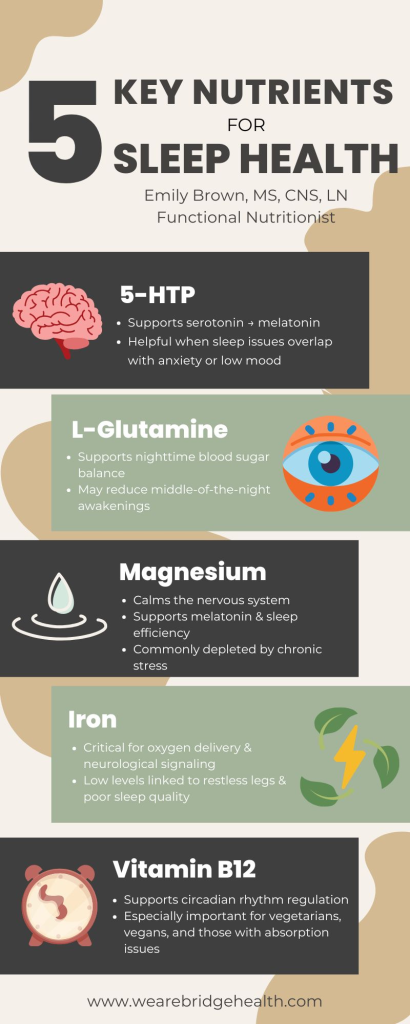
Here’s where my nutrition training really comes into play. When environmental factors and sleep hygiene are addressed but sleep problems persist, I often find myself looking at micronutrient status. Certain nutrients play crucial roles in sleep regulation, and deficiencies can significantly impact sleep quality.
5-Hydroxytryptophan (5-HTP)
This amino acid derivative is a precursor to serotonin and subsequently melatonin. Research published in Alternative Medicine Review has shown that 5-HTP may be useful for preventing or treating sleep terrors in children and may help with insomnia in adults. I find it particularly helpful for clients whose sleep issues seem tied to mood or anxiety.
L-Glutamine
This amino acid can support sleep quality, particularly for those dealing with blood sugar fluctuations overnight. While research is still emerging, some studies suggest it may help reduce nighttime awakenings. I often recommend it for clients who wake up hungry or jittery in the middle of the night.
Magnesium
Ah, magnesium. It’s one of my favorite minerals to discuss because so many Americans are deficient in it. The National Institutes of Health reports that magnesium plays a role in regulating neurotransmitters that promote sleep. It also helps regulate melatonin and supports the parasympathetic nervous system (our “rest and digest” mode).
Research in the Journal of Research in Medical Sciences (2012) found that magnesium supplementation improved subjective measures of insomnia, including sleep efficiency and sleep time, particularly in elderly subjects.
I notice that clients who are under chronic stress often benefit most from magnesium support.
Iron
Iron deficiency is something I screen for carefully, especially in menstruating women and vegetarians. Low iron levels have been associated with restless leg syndrome and periodic limb movements during sleep—conditions that can significantly disrupt sleep quality even when you’re not consciously aware of them.
A systematic review and meta-analysis published in the European Journal of Internal Medicine (2019) by Trotti and colleagues examined 10 randomized controlled trials and found that iron supplementation was associated with significant improvements in restless legs syndrome severity scores and sleep quality. What’s particularly interesting about this research is that iron therapy helped even some patients whose blood iron levels appeared normal—suggesting that the issue may be related to iron availability rather than just overall body stores.
Here’s my question for you: When was the last time you had your iron levels checked? Many people assume they’re fine, but subclinical deficiency is surprisingly common. I also look beyond just serum iron—checking ferritin levels (your iron storage) and Total Iron Binding Capacity (TIBC) and correlating iron markers with others like red blood cell count and hematocrit can reveal deficiencies that wouldn’t show up on a standard blood count.
Vitamin B12
This vitamin is crucial for neurological function and circadian rhythm regulation. Research suggests that B12 supplementation can provide subjective improvements in sleep quality, particularly for shift workers or those with disrupted sleep-wake cycles. The Journal of Clinical Sleep Medicine has published several studies on B12’s role in sleep regulation.
I find B12 particularly important for my vegan and vegetarian clients, people with inflammatory bowel disease, as well as older adults who may have absorption issues.
Melatonin: Handle with Care
Now we come to melatonin—the supplement that’s gained tremendous traction in recent years, and one that I approach with both respect and caution.
Let me be clear about what melatonin is: it’s a hormone synthesized from tryptophan, primarily in the pineal gland but also in the gastrointestinal tract. It plays a central role in regulating our circadian rhythms. According to the National Center for Complementary and Integrative Health (NCCIH), melatonin supplementation can indeed enhance sleep, particularly for certain types of sleep disturbances.But here’s what concerns me: I regularly encounter clients who’ve started taking melatonin without understanding the full picture. They’re often taking doses that are far too high, assuming that “more is better.”
The research tells a different story. Studies published in the Journal of Clinical Endocrinology and Metabolism show that doses as low as 0.1 to 1.0 mg can effectively promote sleepiness and improve sleep quality. Many over-the-counter preparations contain 3, 5, or even 10 mg—doses that may not be more effective and could potentially cause side effects.
There’s also an important nuance in the research that I feel obligated to share. A study examining melatonin supplementation in patients with epilepsy found mixed results—some participants experienced a decrease in seizure frequency, while others experienced an increase (Lancet, 1998). Another study in young men raised concerns about melatonin’s potential impact on reproductive health, suggesting that supplementation might contribute to reduced sperm count, though more research is needed to confirm these findings.
This is why I always encourage clients to work with a healthcare provider when considering melatonin. What’s the right dose for you? What’s the appropriate timing? Are there any interactions with your medications or health conditions? These are questions worth exploring together.
A Functional Medicine Approach to Sleep Optimization
What I’ve come to appreciate in my practice is that sleep is rarely about just one thing. It’s not solely about magnesium deficiency or screen time or stress—it’s usually a constellation of factors, all interacting in ways unique to each person.
When I work with someone on sleep, I find myself asking: What’s your body trying to tell you? Are there patterns you’ve noticed? What happens on nights when you sleep well versus nights when you don’t?
I also address common misconceptions I hear regularly:
“I can catch up on sleep on the weekends.” Unfortunately, research from the Sleep Medicine journal suggests that while weekend recovery sleep can help, it doesn’t fully compensate for chronic sleep debt during the week.
“If I just take a supplement, my sleep will be fixed.” I wish it were that simple. Supplements can be powerful tools, but they work best as part of a comprehensive approach that includes sleep hygiene, stress management, and addressing underlying health conditions or, as mentioned above, nutrient deficiencies.
“I’m just a naturally bad sleeper—nothing will help.” This belief breaks my heart because I’ve seen so many people improve their sleep when we identify and address the root causes. Your sleep can get better.
When to Test for Nutrient Deficiencies Affecting Sleep
If you’re struggling with sleep, I encourage you to approach it with curiosity rather than frustration. What might your body be telling you? What small changes could you experiment with?
Consider keeping a sleep journal for a week or two, noting not just how long you slept but what you ate, when you exercised, your stress levels, and how you felt the next day. Patterns often emerge that can guide your next steps.
And please, don’t hesitate to seek professional support. Whether that’s working with a nutritionist to assess your micronutrient status, consulting with a sleep specialist, or talking with your doctor about underlying health conditions—you deserve restful, restorative sleep.
Because here’s what I know after years in this field: sleep isn’t a luxury. It’s a biological necessity, a foundation for healing, and a gift we can give ourselves each night.
What will you do tonight to honor your need for rest?
Ready to Take a Functional Approach to Your Sleep?
As a nutritionist specializing in integrative wellness for high performers, I help clients identify and address the root nutritional causes of sleep disruption. Let’s create your personalized sleep optimization plan.
References
Birdsall, T. C. (1998). 5-Hydroxytryptophan: A clinically-effective serotonin precursor. Alternative Medicine Review, 3(4), 271-280. Retrieved from https://pubmed.ncbi.nlm.nih.gov/9727088/
Centers for Disease Control and Prevention. (2024). “FastStats: Sleep in Adults.” Retrieved from https://www.cdc.gov/sleep/data-research/facts-stats/adults-sleep-facts-and-stats.html
Dengate, S., & Ruben, A. (2002). Controlled trial of cumulative behavioural effects of a common bread preservative. Journal of Paediatric Child Health, 38(4), 373-376. Retrieved from https://pubmed.ncbi.nlm.nih.gov/12173999/
Abbasi, B., Kimiagar, M., Sadeghniiat, K., Shirazi, M. M., Hedayati, M., & Rashidkhani, B. (2012). The effect of magnesium supplementation on primary insomnia in elderly: A double-blind placebo-controlled clinical trial. Journal of Research in Medical Sciences, 17(12), 1161-1169. Retrieved from https://pubmed.ncbi.nlm.nih.gov/23853635/
Avni, T., Reich, S., Lev, N., & Gafter-Gvili, A. (2019). Iron supplementation for restless legs syndrome: A systematic review and meta-analysis. European Journal of Internal Medicine, 63, 34-41. Retrieved from https://pubmed.ncbi.nlm.nih.gov/30798983/
Leger, D., Richard, J. B., Collin, O., Sauvet, F., & Faraut, B. (2020). Napping and weekend catchup sleep do not fully compensate for high rates of sleep debt and short sleep at a population level. Sleep Medicine, 74, 278-288. Retrieved from https://pubmed.ncbi.nlm.nih.gov/32866843/
National Center for Complementary and Integrative Health. (2023). “Melatonin: What You Need to Know.” National Institutes of Health. Retrieved from https://www.nccih.nih.gov/health/melatonin-what-you-need-to-know
National Heart, Lung, and Blood Institute. (2025). “Sleep Apnea.” National Institutes of Health. Retrieved from https://www.nhlbi.nih.gov/health/sleep-apnea
National Sleep Foundation. (2023). “Recommended Bedroom Temperature for Sleep.” Sleep.org. Retrieved from https://www.thensf.org/sleep-tips/#:~:text=10%20Tips%20for%20a%20Better,%C2%A92026%20National%20Sleep%20Foundation.
NHS inform. (n.d.). “Myalgic Encephalomyelitis (ME) or Chronic Fatigue Syndrome (CFS).” NHS Scotland. Retrieved fromhttps://www.nhsinform.scot/illnesses-and-conditions/brain-nerves-and-spinal-cord/myalgic-encephalomyelitis-me-or-chronic-fatigue-syndrome-cfs/
Sheldon, S. H. (1998). Pro-convulsant effects of oral melatonin in neurologically disabled children. Lancet, 51(6), 1625-1627. Retrieved from https://pubmed.ncbi.nlm.nih.gov/9643754/
Zhdanova, I. V., Wurtman, R. J., Regan, M. M., Taylor, J. A., Shi, J. P., & Leclair, O. U. (2001). Melatonin treatment for age-related insomnia. The Journal of Clinical Endocrinology & Metabolism, 86(10), 4727-4730. Retrieved from https://pubmed.ncbi.nlm.nih.gov/11600532/